
The hypertension control system
Hypertension is common, consequential and clinically well understood. But most healthcare systems, even with effective medicines available and capable clinicians in place, are not organised to take responsibility for blood pressure control at a population level. Preventable harm persists as a result. What is missing is not knowledge or medicine but a set of ordinary capabilities: a defined population, real blood pressure readings, standard treatment and review rules, reliable follow-up and payment that rewards continuity. Assembling them for hypertension is also the most practical way to begin delivering better chronic care.

11 August 2026
12.1 min read
Hypertension is a problem of system design
Poorly controlled hypertension is silent for years then reappears as stroke, heart failure, kidney disease, dialysis and disability causing severe harm and much avoidable cost. The scale is evident: the World Health Organization counted 1.4 billion adults living with hypertension in 2024, with only roughly one in five controlled. [1]
The parts of the system are busy. Medical schemes, administrators, managed-care organisations, provider networks, pharmacies, clinics and clinicians generate consultations, authorisations, prescriptions, medicine claims and payments. None of that activity reliably produces continuity of care or blood pressure control.
Because hypertension so often coexists with obesity, diabetes, dyslipidaemia, chronic kidney disease and cardiovascular disease, the opportunity is larger than one condition. It is to build a better chronic care system, starting with hypertension. [3–5]
The Institute for Healthcare Improvement describes this kind of infrastructure as a Care Operating System – a layer linking clinical care, operations, informatics and analytics so that risk is detected, responses are coordinated and learning happens. In hypertension it is whatever converts a raised reading in the clinic or at home, or a missed medicine refill, into action. [2,12]
The current reality
South Africa’s private sector is often described as though it were already a system. It is better understood as a set of capable but partly disconnected actors with different roles, incentives, information and time horizons.
Schemes and administrators pay claims and carry downstream financial risk that may materialise only after the member has moved to another scheme. Managed care and disease management structures handle authorisation, formularies and selected chronic care functions, reporting quarterly or annually on process rather than on blood pressure values. General practitioners diagnose, prescribe, review and refer but lack a system or population view. Pharmacies dispense and, increasingly, provide convenient access points, but the encounter is transactional. Specialists are drawn in, briefly, when care becomes complex.
The parties with the strongest financial interest in preventing stroke, heart failure and kidney failure are usually not the ones making day-to-day clinical decisions. The clinicians carrying most of the treatment burden are not always given the data or support that population-level follow-up requires. Data are fragmented. Payment tends to reward activity rather than continuity or long-term outcome. In this environment it is possible to fund a great deal of chronic care without achieving disease control. [6–9,11] This pattern is seen nationally. Between 1998 and 2016, treatment among South Africans aware of their hypertension rose from roughly one in ten to more than four in five, while control among those treated reached only 26% in men and 30% in women. [13]
The Competition Commission’s 2019 Health Market Inquiry set out the broader context: outcomes measurement in the private sector was weak, quality information was neither visible nor comparable, and competition on value suffered as a result. [6]

What a hypertension control system needs
Eight capabilities.
- A defined population. It should be possible to count who is likely to have hypertension, who has been diagnosed, who is on treatment, who has fallen out of care and whose blood pressure remains above target. Without a denominator, improvement is guesswork. [6] In 2017 the Council for Medical Schemes recorded 90.6 per 1,000 beneficiaries as registered and verified on a chronic benefit, and 160.6 per 1,000 as having at least one hypertension claim. [14]
- A usable blood pressure data stream. Claims, registrations and prescription records are necessary but not sufficient. The system needs actual readings, repeated often enough to classify control and detect persistent non-control. [6]
- Prevention and risk reduction. Hypertension cannot be reduced to prescribing. Salt reduction, weight, physical activity, alcohol, smoking, sleep and metabolic risk belong in the model, not alongside it. [3–5]
- Standard treatment and review rules. Common conditions benefit from standardised operations: protocol-based initiation, simple regimens, defined review intervals, intensification when blood pressure persists above target, and triggers for stepping care up. [4,5]
- Follow-up capacity. Someone must act when a patient does not return, stops collecting medicine, submits raised home readings or is uncontrolled on current treatment. Hypertension cannot be managed through isolated consultations.
- Escalation pathways. A minority of patients have resistant, unusually severe or early-onset hypertension, or coexisting chronic kidney disease, very high cardiovascular risk or repeated treatment failure. Routes to investigation and specialist review must be defined and readily available. [5]
- Feedback and improvement. Performance should be visible to clinicians, networks and programmes – not for ranking but so that control is visible for learning and action.[6–8]
- One operating model should serve hypertension, diabetes, obesity-related disease, kidney risk and cardiovascular disease, rather than several disconnected programmes. [3–5,12]
What to measure
A mature system should be able to report: [6–8]
- estimated hypertensive population
- diagnosed and treated prevalence
- persistence on treatment at 12 months
- proportion with enough readings to classify control
- control rate, and proportion with unknown control status
- medicine refill-gap rate
- median time to intensification after an uncontrolled reading
- referral rate for resistant or complex hypertension
Not all of this is available now. Several of these measures can be built from data schemes already hold; the rest depend on capturing actual readings.
Blood pressure control works as a quality measure elsewhere. In the United States, the Centers for Medicare & Medicaid Services’ 2025 Quality ID #236 defines it as the percentage of hypertensive patients aged 18 to 85 whose most recent blood pressure is below 140/90 mmHg, and NCQA’s HEDIS programme1 uses a comparable measure. [7,8] South Africa’s private sector has no equivalent; it reports registrations and claims, not control.
Who does what
Control begins with general practitioners, who diagnose, assess cardiovascular risk, initiate and intensify treatment, and decide when referral is appropriate. [4,5] They should not have to carry the system alone.
Schemes, administrators and managed-care organisations can define the target population, build registries and dashboards, make control visible, flag refill gaps, support recall, and encourage coherent pathways across providers and sites. There is no need to take over clinical care and decision making; this is about creating the conditions in which control becomes more likely.
Nurses, pharmacists and other support staff can make continuity real through repeat measurement, outreach, adherence support, protocol-based review, reinforcement of lifestyle measures and early recognition of loss of control. [4,5,9–11]
Pharmacy-linked clinics and other access points improve convenience and reach. A blood pressure check there is only useful if it connects to a shared record and pathway that registers what was found and what followed: adjustment, refill, follow-up, referral or disease-management support.
Specialists are essential for the minority whose care is not routine – resistant or possibly secondary hypertension, chronic kidney disease or other major comorbidity, and persistent loss of control despite appropriate treatment. [5]
A control system does not remove these roles. It makes them fit together.
Incentives
None of this emerges on its own, and the current incentive environment works against it.
Consultations, tests and medicines are easier to reimburse than shared accountability for blood pressure control. A scheme benefits if fewer strokes and dialysis cases appear years later, but clinicians do the work of follow-up. A pharmacy can improve access without any reason to invest in integration. Reporting, network expectations, quality-improvement support and carefully designed payment will all be needed, and the design should avoid threshold-chasing and administrative load. The point is to make prevention, continuity and control worth doing.
More aligned purchasing is possible. In the WHO case study of the PPO Serve / Value Care Team model, risk-adjusted capitation combined with quality-linked payment was associated with lower-than-expected medical admission rates in an early pilot. [9–11]
A path forward
Figure 1 sets out the drivers of population blood pressure control and of reduced avoidable stroke, heart failure, chronic kidney disease and vascular admissions. None of them is exotic. They are the ordinary requirements of reliable chronic care, made visible as a system. [3–6,9–12]
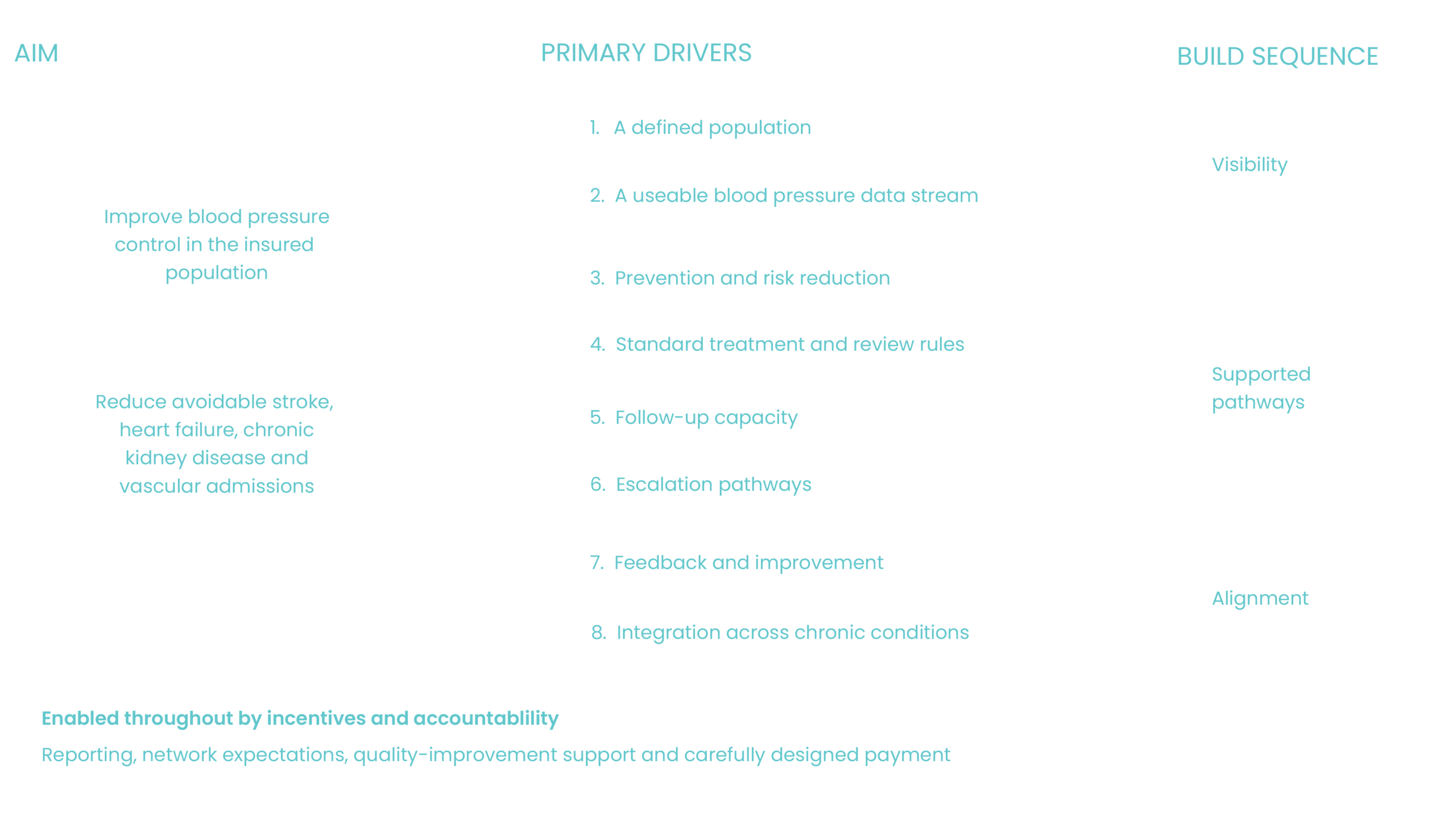
Figure 1. Driver diagram for a hypertension control system. The eight primary drivers are the eight capabilities set out above. Incentives and accountability act on all eight.
Three steps follow.
- Visibility. Define the hypertensive population. Improve capture of readings. Estimate who is controlled, uncontrolled and unknown, rather than inferring care from claims, authorisations and dispensing data.
- Supported pathways. Build registries, recall, refill tracking, home blood pressure monitoring linked to action, practical lifestyle support, team-based follow-up, and clear escalation rules.
- Alignment. Use feedback, network expectations, quality-improvement methods and measures that make better control both more likely and more rewarding. The same infrastructure can carry other chronic conditions rather than adding more isolated programmes.
None of this requires the private sector to become a single centrally controlled entity. It requires the sector to behave more like a system than it currently does.
A healthcare sector that can do these things for the most common and most measurable chronic condition creates the basis for confidence throughout chronic care. Success here would be more than a disease programme. It would be a way of managing the overlapping conditions that drive most adult illness, disability and cost.
1 The National Committee for Quality Assurance (NCQA) is a private, non-profit group that checks and scores American health insurance plans (medical schemes). HEDIS (Healthcare Effectiveness Data and Information Set) is the testing tool that NCQA created and owns to measure how well those health plans perform.
References
[1] WHO publication page for the Value Care Team model in South Africa.
https://www.who.int/publications/b/66524
[2] IHI on embedding quality and safety within clinical operations.
[3] WHO hypertension fact sheet.
https://www.who.int/news-room/fact-sheets/detail/hypertension
[4] WHO HEARTS technical package.
https://www.who.int/publications/i/item/WHO-NMH-NVI-18-14
[5] WHO HEARTS technical package.
https://www.who.int/publications/i/item/WHO-NMH-NVI-18-14
[6] WHO guideline for the pharmacological treatment of hypertension in adults.
https://www.who.int/publications/i/item/9789240033986
[7] Competition Commission Health Market Inquiry final report
[8] Centers for Medicare & Medicaid Services. Quality ID #236: Controlling High Blood Pressure. .
[9] eCQI / CMS measure page: Controlling High Blood Pressure.
https://ecqi.healthit.gov/ecqm/ec/2025/cms0165v13
[10] WHO IRIS: Value Care Team model in South Africa case study.
https://iris.who.int/server/api/core/bitstreams/7f6a7ba4-b675-446a-9ef5-6f2ff80cd916/content
[11] WHO / WKC policy brief on the Value Care Team model in South Africa.
[12] IHI Care Operating System overview
https://www.ihi.org/partner/consulting/ihi-care-operating-system
[13]World Health Organization. Global report on hypertension 2025.
https://www.who.int/publications/i/item/9789240115569
[14]Peer N, Uthman OA, Kengne AP. Rising prevalence, and improved but suboptimal management, of hypertension in South Africa: a comparison of two national surveys. Global Epidemiology 2021;3:100063.
https://www.sciencedirect.com/science/article/pii/S2590113321000171
[15]Council for Medical Schemes. Prevalence of chronic diseases in the population covered by medical schemes in South Africa. Research and Monitoring Unit, March 2019.
Get an email whenever we publish a new thought piece
Respondents are mostly medical schemes and insurers (46%) and providers, clinicians and managed care (19%). Nine in ten are based in South Africa, the rest in regional countries. Survey
3.9 min read

Some statistics worth examining Traditional medicine is an important component of African health systems yet surprisingly little is known about the true extent to which people use these services. In South
11.2 min read

Meet our experts
Author
More Insights
Focused Thought Pieces